
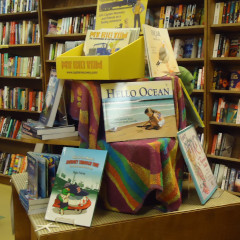
An Orem voter asked me today for my opinion about the Orem Public Library participating in LGBTQ+ Pride Month celebrations by hosting displays that feature relevant books. Here’s my response, for whomever it may interest and for whatever it may be worth…
Although the library is a public institution, it’s also essentially a business. And I think that any business should serve its customers, catering to their needs and virtuous wants.
On the subject of virtue, I consider myself to be morally-obligated to respect the equal God-given (or natural) rights of LGBTQ+ folks to freely preach-and-practice what they please, to the extent that they don’t overstep the innate limits of their own innate rights to violate the equal innate rights of other people; however, at the same time, I consider myself to be not-morally-obligated to assist them in promoting acceptance of their lifestyles to those around them, but to freely exercise my own rights within their proper limits to preach-and-practice what I please instead.
Along with moral considerations, there are also economic considerations—and, as for what Orem’s populace wants, I’m not convinced that they currently show widespread demand to read LGBTQ+ books compared with other localities, so I see little reason for Orem’s public library to expend major resources to try to cater to minor interests. Orem’s public library doesn’t need to feature certain of its books to honor annual celebrations that are popular in other parts of the USA but not here. Nor does Orem’s public library even need to purchase books simply because they exist. I think that business decisions about both which existing books to buy and which bought books to feature should be made with sight of how to best serve the library’s full range of patrons, a few of whom may appreciate LGBTQ+ books but most of whom don’t. If some factions believe that they’re being under-served by the Orem Public Library as a result of decisions like this, then they’re always welcome to freely try to persuade library decisionmakers to change such policies—or, as long as the USA remains a relatively-free country, they’re also welcome to engage in free enterprise by establishing their own startup lending libraries to cater to under-served and/or niche market segments. Free markets, in which God-given rights to both property and contract are fully respected, are wonderful at steadily innovating over time toward greater efficiency, effectiveness, and proper customization at serving customers well.
Serving customers effectively becomes more difficult in some ways whenever businesses cease being accountable directly to customers, as politicians interject themselves between them as middlemen—and, frankly, I’m not keen on acting in this capacity. But, as long as Orem’s city council doubles as the library’s Board of Directors… If elected as city councilor, then my executive business decision (as one of 7 board members) would be to not bother to post such displays, but instead to feature sets-of-books that would cater to more-popular customer demands.
So, I hope that this e-mail explains sufficiently what my decision would be about Pride displays, and why-and-how I arrived at this decision. If not, then I’d be happy to try again.
– David Edward Garber
I’d be curious to know others’ thoughts about the Orem Public Library and especially how it could serve its patrons better. Which local market segments are being overrepresented or underrepresented? Which great innovations should our library consider implementing?
Speaking of innovations, libraries in the Information Age are surprisingly still thriving, but perhaps because many are embracing a broader role as community centers focused on intellectually-related pursuits. As a result of this shift in focus, a 21st-century library may include not only books but also (1) social space like a hot-cocoa café with a giant playable chessboard plus a great scenic view, (2) a wide variety of non-book media like CDs and/or DVDs and perhaps even a movie theater, (3) recording space for capturing oral histories, (4) a family-history center to research ancestry, (5) educational space that may provide a variety of classes like (a) English classes for non-native speakers, (b) GED classes for students, (c) reading classes for illiterate adults, and/or (d) technology classes for seniors, (6) commercial space that may offer résumé help and/or business workshops, (7) innovation space, (8) bookmobiles and/or other delivery services, and so forth. Perhaps someday flying drones will safely efficiently drop-off checked-out books at patrons’ doorsteps on-demand.
One of the best ways to spur innovation is through free markets. Although private libraries thrived before public libraries prevailed, some library fans like Penn Jillette argue that compelling libraries is immoral, and that they would thrive better if re-privatized. What do you think?
 David for Liberty