
Categories
Views

Library Displays

An Orem voter asked me today for my opinion about the Orem Public Library participating in LGBTQ+ Pride Month celebrations by hosting displays that feature relevant books. Here’s my response, for whomever it may interest and for whatever it may be worth…

Although the library is a public institution, it’s also essentially a business. And I think that any business should serve its customers, catering to their needs and virtuous wants.

On the subject of virtue, I consider myself to be morally-obligated to respect the equal God-given (or natural) rights of LGBTQ+ folks to freely preach-and-practice what they please, to the extent that they don’t overstep the innate limits of their own innate rights to violate the equal innate rights of other people; however, at the same time, I consider myself to be not-morally-obligated to assist them in promoting acceptance of their lifestyles to those around them, but to freely exercise my own rights within their proper limits to preach-and-practice what I please instead.

Along with moral considerations, there are also economic considerations—and, as for what Orem’s populace wants, I’m not convinced that they currently show widespread demand to read LGBTQ+ books compared with other localities, so I see little reason for Orem’s public library to expend major resources to try to cater to minor interests. Orem’s public library doesn’t need to feature certain of its books to honor annual celebrations that are popular in other parts of the USA but not here. Nor does Orem’s public library even need to purchase books simply because they exist. I think that business decisions about both which existing books to buy and which bought books to feature should be made with sight of how to best serve the library’s full range of patrons, a few of whom may appreciate LGBTQ+ books but most of whom don’t. If some factions believe that they’re being under-served by the Orem Public Library as a result of decisions like this, then they’re always welcome to freely try to persuade library decisionmakers to change such policies—or, as long as the USA remains a relatively-free country, they’re also welcome to engage in free enterprise by establishing their own startup lending libraries to cater to under-served and/or niche market segments. Free markets, in which God-given rights to both property and contract are fully respected, are wonderful at steadily innovating over time toward greater efficiency, effectiveness, and proper customization at serving customers well.

Serving customers effectively becomes more difficult in some ways whenever businesses cease being accountable directly to customers, as politicians interject themselves between them as middlemen—and, frankly, I’m not keen on acting in this capacity. But, as long as Orem’s city council doubles as the library’s Board of Directors… If elected as city councilor, then my executive business decision (as one of 7 board members) would be to not bother to post such displays, but instead to feature sets-of-books that would cater to more-popular customer demands.

So, I hope that this e-mail explains sufficiently what my decision would be about Pride displays, and why-and-how I arrived at this decision. If not, then I’d be happy to try again.

– David Edward Garber

I’d be curious to know others’ thoughts about the Orem Public Library and especially how it could serve its patrons better. Which local market segments are being overrepresented or underrepresented? Which great innovations should our library consider implementing?

Speaking of innovations, libraries in the Information Age are surprisingly still thriving, but perhaps because many are embracing a broader role as community centers focused on intellectually-related pursuits. As a result of this shift in focus, a 21st-century library may include not only books but also (1) social space like a hot-cocoa café with a giant playable chessboard plus a great scenic view, (2) a wide variety of non-book media like CDs and/or DVDs and perhaps even a movie theater, (3) recording space for capturing oral histories, (4) a family-history center to research ancestry, (5) educational space that may provide a variety of classes like (a) English classes for non-native speakers, (b) GED classes for students, (c) reading classes for illiterate adults, and/or (d) technology classes for seniors, (6) commercial space that may offer résumé help and/or business workshops, (7) innovation space, (8) bookmobiles and/or other delivery services, and so forth. Perhaps someday flying drones will safely efficiently drop-off checked-out books at patrons’ doorsteps on-demand.

One of the best ways to spur innovation is through free markets. Although private libraries thrived before public libraries prevailed, some library fans like Penn Jillette argue that compelling libraries is immoral, and that they would thrive better if re-privatized. What do you think?
Categories
News

Facebook Censorship

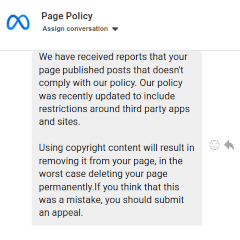
Facebook is threatening to delete my official campaign page soon due to reports that I am defying its policies somehow.

I’m not currently clear which policies they suspect that I’m violating. Initially, it appeared that they were citing copyright violations, but I’ve been using a mix of both public domain images and free stock images, which is perfectly legal. Afterward, it appeared that they were concerned that I was posting violence, nudity, and/or harassment, but these concerns seem unjustified to me. But I worry that, even if there’s no justification for it, then I might still get censored anyway.

I’m a staunch advocate for free speech. I oppose public censorship; I believe that private censorship is legal but unwise.


For whomever it may interest and for whatever it may be worth, I share this letter that I wrote in 2020 to Facebook policymakers…

To whom it may concern:

I joined Facebook in 2007, and I’ve enjoyed using it regularly since 2011 to openly discuss my three passions of religion and family and politics, along with other subjects that interest me. I’ve had no issues with Facebook’s policies to thwart use of its platform for attempted rights-violations like murder or rape or theft, nor to curb pornography. But, since about 2018, I’ve felt appalled by Facebook’s newer policies to silence disfavored viewpoints, whether conservative or merely “fringe.”

I respect that, in accordance with both property rights and contractual rights, Facebook’s owner has a right to impose reasonable rules upon those who use Facebook’s virtual property, just like I have a right to set reasonable rules for guests in my physical home. And, just as I can rightfully kick guests out of my house for expressing opinions that I dislike, Facebook can likewise rightfully ban users from its website for expressing opinions that it disfavors.

However, having a right to do something doesn’t innately make it right to do. And, whenever one person has freely chosen to exercise his/her right to do something foolish, it’s another person’s right (and moral but not legal duty) to freely choose to try to convince that wrongdoer of the error of his/her ways. And that’s why why I’m writing this letter to you today, not because I “hate” you, but because I care enough about you (and my fellow users) to say that…

Open dialogue (not censorship) is innately the best way to correct error, to spread truth, and to make progress, whether as individuals or as societies.

Silencing “wrong” opinions from being freely expressed may superficially seem like a more-effective alternative, but it’s lazy and brutish and uncivilized—and, more importantly, it not only fails to change anyone’s hearts-or-minds for the better but, by forcibly concealing errors from public view, it actually deprives us of opportunities to do so. Or, in other words, correcting error requires addressing error, and error can’t be addressed if it’s not first expressed.

And this is equally true in cases of alleged “hate speech,” which is perhaps overdiagnosed. For example, I believe that it’s foolish to sell oneself deeply into financial bondage to buy frivolous things, but my saying so doesn’t indicate that I’m a hate-filled “debtophobe.” Even if someone’s beliefs are truly rooted in feelings of hatred, then their heart will improve only through persuasion. Coercion can change only outward behavior, instead, and only for as long as it continues.

And, sometimes when we attempt to correct other people, they might correct us instead. To err is human, and we mere mortals are all human, so who among us is fit to judge the truth for everyone else? I’m not, and neither are you. Each of us has an equal God-given (or natural) right to express our perspectives freely, and none of us mere mortals should ever presume ourselves so superior in our correctness that we should habitually prohibit others from contradicting us.

But arrogant people sometimes believe that they are fit to silence any views that diverge from their own, and we sometimes foolishly entrust such people with sufficient power to do so. And this is why conservatives executed Socrates, Catholics suppressed Galileo’s astronomical observations, Nazis burned great works of literature and science, and Soviets denied the science of genetics. Such censors can potentially silence actual errors, also, but it’s safer to leave this task to open dialogue.

One reason that open dialogue is safer than empowering an “expert” to curate everyone else’s communications is this: that, amidst such curated discussion, people might cease to develop their own capacity to discern truth from error, resulting in rampant intellectual laziness and excessive deference. Over time, such a servile society, while impaired in its ability to discern, could become increasingly ripe for captivity in other respects, including subjugation by domestic tyrants.

As Nazi book-burning showed, private censorship can serve as a stepping-stone toward public censorship. And state censorship is significantly worse because politics (more than most professions) naturally attracts the virtuous less than the corrupt, especially the corrupt who habitually deceive for personal gain. We should never entrust such serial liars to operate a Ministry of Truth, which they’d likely use to propagandize us into captivity. Tyranny is naturally facilitated by censorship.

So, whether as a public entity or a private one, let’s please never habitually cast “wrongthink” down the “Memory Hole” by annihilating years of users’ social-media posts. Deleting user accounts is arguably the electronic equivalent of book-burning, which we should leave in history books, rather than revive for the Information Age. As book-burning target Heinrich Heine once wrote, “Where they have burned books, they will end in burning human beings,” and history sadly proved him correct.

So, it’s better to simply let all users freely express their own views as equals, develop their own respective capacities to discern, attempt to both correct error and spread truth, and let the truth speak for itself until it ultimately prevails, even if/when some errors prove unusually stubborn… all without some arrogant self-appointed “expert” distorting the process. In other words, please stop censoring any user content except to thwart rights-violating activity and/or unsolicited pornography.

So, those are my thoughts about this subject, for whatever they may be worth, and I hope that you can sense the truth in them. The pen is mightier than the sword, I believe, which is why the Roman empire has long turned to dust while Christianity endures. And I hope that these timeless concepts of free speech will prove similarly enduring, despite aberrations like Facebook’s. In any case, I thank you for taking a few moments of your valuable time to consider my views about this subject.

David Edward Garber

P. S. This contemplative FEE Out of Frame episode linked below shows how Mark Zuckerberg could have responded to Congress’ efforts to pressure Facebook to censor itself. I’m sad that he chose a very different course for now. Perhaps next time?

http://www.youtube.com/watch?v=eKesrXN9wjw

– David Edward Garber

Please stand firmly for open dialogue rather than censorship. Please help others to do likewise. Please do so while you still can.


UPDATE: I felt relieved to discover that this was merely a scammer’s attempt to hack my account, not Facebook’s attempt to delete my account. Even so, I worry about ongoing federal attempts to secretly collude with social-media companies to censor disfavored opinions, and I know too many people personally whom Facebook has censored or even banned. Such behavior is unworthy of a free society like ours should be. Please champion open dialogue and please vote accordingly!